Heating Pad For Ankle Explained: A UK Buyer's Guide
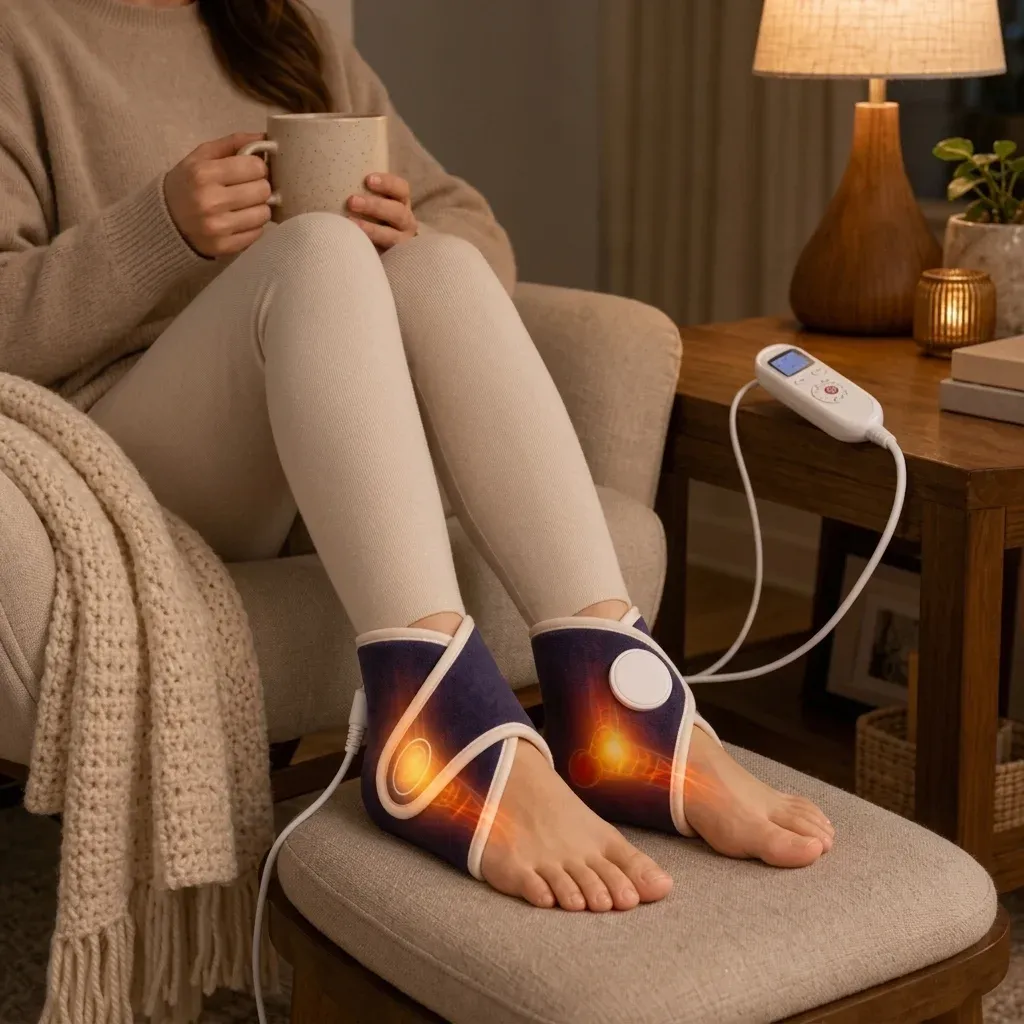
Short answer: a heating pad for ankle use is a contoured electric wrap that warms the ankle joint and the Achilles far more evenly than a flat mat or a hot water bottle. If you are on your feet all day, the practical win is simple: you sit down, wrap it on, choose a heat level, and get steady warmth without holding anything in place.
After a long standing shift — retail, hospitality, a hospital ward, a warehouse floor — the last thing you want is to boil a kettle and set up a foot spa. You want to drop onto the sofa and get warmth around both tired ankles straight away. That is where a purpose-made heating pad for the ankle earns its keep.
Key things to know about a heating pad for ankle use
- The ankle is mostly bone, tendon and ligament, so a contoured pad that wraps the joint holds heat far better than a flat mat.
- A flat pad cannot cover both sides of the ankle and the Achilles at once; a wrap-style pad can.
- Look for adjustable straps, easy heat settings and an auto shut-off, plus proper UK electrical safety marking.
- A two-pack means you can warm both ankles at the same time instead of swapping one pad from side to side.
- Heat is for comfort and everyday stiffness, not for a fresh, swollen injury — check NHS guidance if you are unsure.
Why does the ankle need a contoured pad, not a flat mat?
The ankle is a hard-working, weight-bearing joint with relatively little soft tissue over the bone, which is exactly why feet and ankles are often the first parts of you to feel the chill in a draughty house. A flat heating mat is designed for a broad, flat surface, so on the ankle it only touches one face of the joint and leaves the Achilles at the back cold.
A contoured heating pad for the ankle wraps around the joint so warmth reaches the inner and outer ankle bones and the Achilles together. You get more even, hands-free coverage and the pad stays where you put it. If you specifically want the snug, sock-like feel of a fully wrapped design, our ankle warmer wrap guide focuses on fit.
How do you choose the best heating pad for an ankle?
Contoured fit and full coverage
The most important feature is how the pad handles the shape of the ankle. Look for adjustable hook-and-loop straps that hold the heating area flush against the skin, wrapping the Achilles at the back as well as the bony points on either side, so little warmth is lost to the air.
Simple, controllable heat
Several heat levels are more useful than one fixed setting, because how much warmth you want depends on the day. A lower setting suits a long, relaxed session on the sofa; a higher one is better for a short burst after a particularly cold shift.
Auto shut-off and easy controls
An automatic shut-off is genuinely reassuring if you tend to sit down, get comfortable and doze off. Controls should be obvious to use without hunting through a manual every time.
UK electrical safety and a proper plug
Check for UK safety marking such as UKCA or CE, and a BS 1363 UK 3-pin plug so it is ready for British sockets out of the box — no adapters, no waiting on a mismatched plug. If you need both ankles covered at once, a two-pack saves swapping a single pad from foot to foot.
Is heat good for tired or stiff ankles?
Warmth is a well-established way to make a stiff, cold-feeling ankle feel looser and more comfortable, and many people find it helps them relax after a long day standing. According to NHS guidance on aches and joint stiffness, applying heat can help ease ongoing stiffness and muscle tension — but it is not the right choice straight after a new injury where there is swelling or heat already. If your ankle is freshly injured, badly swollen or you are otherwise unsure, it is sensible to seek advice from a healthcare professional or NHS 111 before using heat.
If you would rather not be near a socket, it is worth weighing a plug-in pad against a rechargeable ankle heating pad, and for the full overview of formats and safe use see our ankle heat pad guide.
The AnkleHeati heated ankle wrap
The AnkleHeati set is a 2-pack of mains-powered heated ankle wraps shaped to sit around the ankle joint and the Achilles at the back. Each wrap has three heat levels (roughly 40, 50 and 60°C), a 90-minute auto shut-off, an adjustable fastening and a soft fleece-lined neoprene blend, and it runs from a BS 1363 UK 3-pin plug (UKCA, CE, RoHS and WEEE marked). It is £88.98 inc. VAT (RRP £63.99, 10% off), rated 4.8 out of 5 from 476 reviews, and ships with free UK delivery, next-day dispatch and 30-day returns.
Sink into steady warmth after a long shift
Shop the AnkleHeati 2-pack — £88.98Frequently asked questions
Why is a contoured heating pad better than a flat mat for the ankle?
The ankle is a curved joint with little soft tissue, so a flat mat only touches one side and leaves the Achilles cold. A contoured pad wraps around the joint, warming both ankle bones and the Achilles evenly, and it stays in place hands-free.
What features matter most in a heating pad for the ankle?
Prioritise a contoured, adjustable fit, several controllable heat levels, an automatic shut-off, and UK electrical safety such as UKCA or CE marking with a BS 1363 plug. A two-pack is useful if you want to warm both ankles at once.
Is a heating pad good for tired ankles after standing all day?
Many people find gentle warmth soothing and relaxing for cold, stiff-feeling ankles after a long shift. Heat suits ongoing stiffness rather than a fresh, swollen injury; if the ankle is newly hurt or swollen, follow NHS advice before applying heat.
Does an ankle heating pad come with a UK plug?
A UK-ready pad uses a BS 1363 three-pin plug so it works with British sockets without an adapter. The AnkleHeati wraps use a BS 1363 UK plug and are UKCA, CE, RoHS and WEEE marked.
Ready to try AnkleHeati?
Shop Now — £88.98